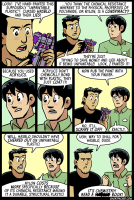
I’ve only ever been to one Comic Book Store in my life time (Sadface) but it was fairly nice actually although I did overhear someone who thought Disney owned both Marvel AND DC but still.
Eh, to be fair that one’s probably only a matter of time. Eventually everything in the world will be owned by Disney, Google, or Coca-Cola and that’s when we find out just how accurate Orwell was.
This comment bothers me so much. Orwell was talking about the world getting taken over by big government, not big monopolies. IMHO both are bad, but gah, get your literary ideologies right.
(And an archive binge allows me to respond to an ancient response that will never be seen. Hooray?)
… That’s not really where I was going with that. The line of thinking I was following was the companies in question eventually buying countries as well (‘countries’ falling under the umbrella of ‘everything in the world’ last I checked) at which point they’d become the government. But thanks for assuming that I’d missed the point of the novel because I made a joke that twisted the backstory ever so slightly.
Orwell never really spoke of corporate power and corporate nationhood. Other dystopian novelists covered that better, especially cyberpunk authors and those influenced by them.
It’s good to know Orwell, but it’s better to read more. I recommend:
* “Neuromancer,” “Count Zero,” and “Mona Lisa Overdrive,” by William Gibson.
* “The Stars My Destination,” by Alfred Bester. (Also, unrelated, but his book “The Demolished Man” is equally fast-paced and full of awesome.)
* “Market Forces,” by Richard Morgan.
* “Brave New World,” by Aldus Huxley, of course. (Though more statist than my other examples, it is a satire of American consumer culture.)
* “The Space Merchants,” by Frederick Pohl.
* “The Iron Heel,” by Jack London.
* “Do Androids Dream of Electric Sheep?” by Philip K. Dick (the inspiration for Blade Runner). Really, anything by Philip K. Dick has a marvelously depressing edge.
All of these deal with corporations and/or consumer society with a terrifying grip on society.
BAZINGA!
I’ve only ever been to one Comic Book Store in my life time (Sadface) but it was fairly nice actually although I did overhear someone who thought Disney owned both Marvel AND DC but still.
Eh, to be fair that one’s probably only a matter of time. Eventually everything in the world will be owned by Disney, Google, or Coca-Cola and that’s when we find out just how accurate Orwell was.
This comment bothers me so much. Orwell was talking about the world getting taken over by big government, not big monopolies. IMHO both are bad, but gah, get your literary ideologies right.
(And an archive binge allows me to respond to an ancient response that will never be seen. Hooray?)
… That’s not really where I was going with that. The line of thinking I was following was the companies in question eventually buying countries as well (‘countries’ falling under the umbrella of ‘everything in the world’ last I checked) at which point they’d become the government. But thanks for assuming that I’d missed the point of the novel because I made a joke that twisted the backstory ever so slightly.
Your comment -was- pretty ill-conceived, dude.
It’s Buy-n-Large.
Orwell never really spoke of corporate power and corporate nationhood. Other dystopian novelists covered that better, especially cyberpunk authors and those influenced by them.
It’s good to know Orwell, but it’s better to read more. I recommend:
* “Neuromancer,” “Count Zero,” and “Mona Lisa Overdrive,” by William Gibson.
* “The Stars My Destination,” by Alfred Bester. (Also, unrelated, but his book “The Demolished Man” is equally fast-paced and full of awesome.)
* “Market Forces,” by Richard Morgan.
* “Brave New World,” by Aldus Huxley, of course. (Though more statist than my other examples, it is a satire of American consumer culture.)
* “The Space Merchants,” by Frederick Pohl.
* “The Iron Heel,” by Jack London.
* “Do Androids Dream of Electric Sheep?” by Philip K. Dick (the inspiration for Blade Runner). Really, anything by Philip K. Dick has a marvelously depressing edge.
All of these deal with corporations and/or consumer society with a terrifying grip on society.
Well crap, now they also own Lucasarts. It’s happening!
Somebody finally put Ethan in his place.
where is Galasso putting his hands on the last frame?
As infuriating as it is, and I can’t believe I’m saying this: Galasso’s got a point. At least from the business point of view.
if you wish to get paid for being rude to the customers you should go and work at a coffee shop
Or a game store